Our History
By Leigh Sherrill
Published in the Boothbay Register, March 21, 2022
How did St. Columba happen to come to Boothbay Harbor? This ancient saint was known for wandering in his coracle, a small, nutshell shaped boat, from Ireland to Scotland, some say because he became crosswise to a Scottish king. A fine poet and a brilliant scholar, he founded a number of important monasteries in Ireland, before founding the monastic community on the island of Iona in Scotland, a center for spirituality that continues to this day. In his words,
Behold Iona!
A blessing on every eye that see it!
He who does good for another here,
Will be repaid a thousandfold!*
Some Protestant churches include the name of the community where they reside in their titles, or the name of their denomination, but Roman Catholic churches and Episcopal churches often include the name of a saint. The summer chapel of All Saints by-the-Sea scooped all saintly reference into its name. The name of the Roman Catholic church in our town, Our Lady Queen of Peace, refers to the Virgin Mary. Prior to St. Columba’s coming to Boothbay Harbor, folks who wished to worship according to the Episcopal liturgy after the summer chapel closed, had to travel to St. Andrews Episcopal Church in Damariscotta, St. Phillips Church in Wiscasset, or even further afield to Bath or Brunswick.
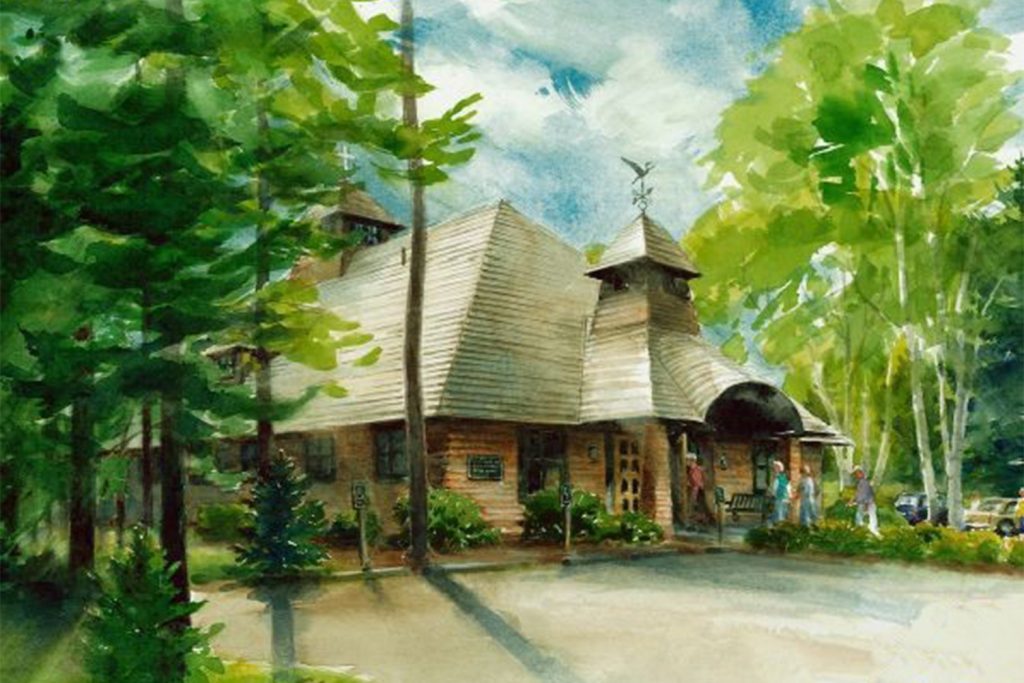
So after meeting for some time for worship in the home of Sydney and Joseph “Joe” Klenk, then in several other locations including the Boothbay Railroad Village, money was raised to purchase land and build a church on Emery Lane in Boothbay Harbor. Although at least one person initially referred to the project as the “church in the swamp,” the setting is quite peaceful yet convenient to St. Andrews Village and the town. With a variety of examples to explore, the building committee opted for flexible space, using chairs rather than fixed pews for the sanctuary, and wide doorways with folding doors to open further space on either side of the worship space. All areas in the building currently being used are fully accessible.
Perhaps not for our post office, but theologically a church is not a building; it is the people and their actions. From the beginning St. Columba’s has followed the example of their namesake by helping others. Joining with the summer chapel to form a Joint Outreach Committee, they first donated funds and took action to help others in our community. Instrumental in founding the Community Resource Council, they joined with other churches to increase the effectiveness of those efforts. Along with several other denominations, they welcome all persons to join in worship. As the weekly activities demonstrate, the building is available for groups involved in improving health and well-being.
St. Columba is described as “a man who loved the world as much as he loved the places of the soul; whose long and sometimes difficult journey never ceased to burn with the light of inspiration and a deep love for all created things.”* This is the person whose name personifies this parish. As a parish we are inspired to follow his example in today’s world.
*Drinking from the Sacred Well” by John Matthews